As a business owner navigating the rapidly evolving digital landscape, you’ve likely encountered terms like “frontend” and “backend” countless times. Perhaps you’re grappling with a new website project, an e-commerce platform upgrade, or the development of a custom application. The jargon can be overwhelming, often leading to confusion, project delays, and unexpected costs when you’re not entirely sure what you’re paying for or why certain technical decisions are being made.
Many entrepreneurs find themselves in a challenging position: they know their business needs robust digital products, but the technical intricacies feel like a black box. This lack of understanding can hinder effective communication with development teams, leading to misaligned expectations and frustrating outcomes. You might struggle to articulate your vision, evaluate proposals, or even monitor progress effectively, leaving critical aspects of your digital strategy to chance.
This article is designed to demystify the core concepts of frontend and backend development, translating complex technical ideas into clear, actionable insights for business owners. By the end, you’ll not only understand the fundamental differences but also gain the knowledge to make informed decisions about your digital product development, ensuring better outcomes and more efficient use of resources. Let’s unlock the secrets to successful web development and software architecture together.
What are the key differences between frontend and backend development, and how can this understanding benefit business owners?
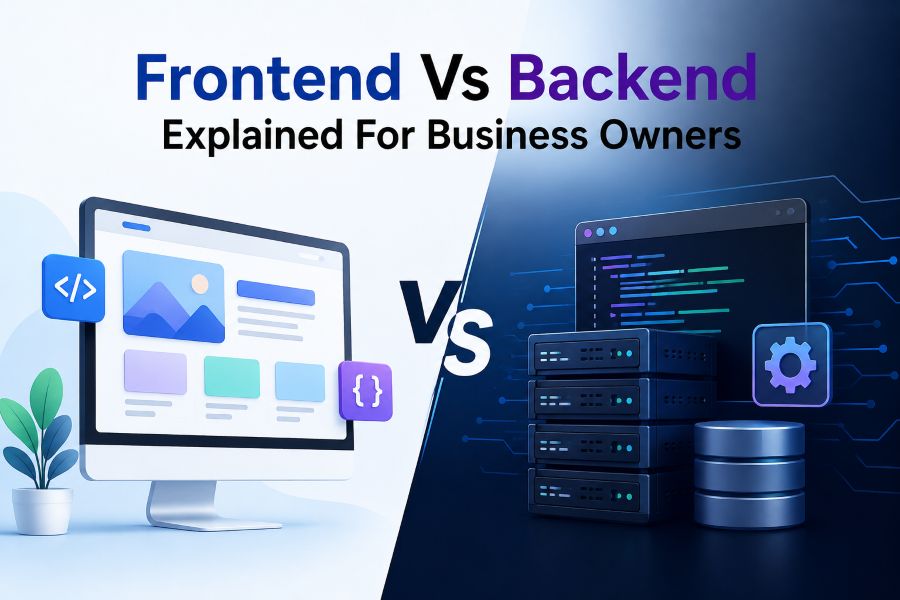
Frontend development focuses on everything users see and interact with (the “client-side”), while backend development handles the server-side logic, databases, and application functionality that users don’t directly see. Understanding these distinctions empowers business owners to make informed decisions, optimize resource allocation, and effectively communicate with technical teams, ensuring robust and user-friendly digital products.
Ever wondered what’s happening behind the scenes when you click a button on a website? Frontend is the “face” – what you see and interact with, built with tools like HTML, CSS, and JavaScript. Backend is the “brain” – the servers and databases powering everything, often using languages like Python or PHP. For business owners, knowing the difference means you can smartly plan projects, hire the right web development experts, and ensure your digital products are both beautiful and powerful, avoiding costly missteps and delays.
Understanding Frontend Development
Imagine your digital product – be it a website, a mobile app, or a web application – as a beautifully designed shop window. Frontend development is essentially the art and science of crafting that window, ensuring it’s not only visually appealing but also easy for customers to navigate and interact with. It’s all about the “client-side” experience, meaning everything that happens directly in a user’s web browser or on their device.
The primary goal of frontend development is to build the user interface (UI) and user experience (UX). This encompasses the layout, colors, fonts, images, navigation menus, forms, buttons, and all other interactive elements. A well-executed frontend should be intuitive, responsive (meaning it adapts to different screen sizes, like desktops, tablets, and smartphones), and engaging, drawing users in and guiding them effortlessly through your digital offering. For a business, this translates directly to user satisfaction, conversion rates, and brand perception.
Key technologies that frontend developers use include:
- HTML (HyperText Markup Language): This is the foundational structure of any webpage. Think of it as the skeleton that defines content like headings, paragraphs, images, and links. Without HTML, there’s no web page.
- CSS (Cascading Style Sheets): CSS is the design layer. It dictates how HTML elements look – their colors, fonts, spacing, animations, and overall layout. CSS transforms raw HTML into a visually appealing and branded experience.
- JavaScript: This is the magic behind interactivity. JavaScript enables dynamic features like image sliders, interactive forms, animations, pop-up menus, and real-time updates without needing to reload the entire page. It makes your digital product come alive.
Beyond these core languages, frontend developers often work with frameworks and libraries like React, Angular, or Vue.js, which streamline development and create more complex, single-page applications. They also use tools to optimize performance, ensure cross-browser compatibility, and improve accessibility. For business owners, understanding frontend means appreciating the value of a strong first impression and a smooth user journey. It’s about ensuring your digital products are not just functional, but also delightful to use, enhancing customer engagement and ultimately driving your business goals. You might even use tools like Canva to create initial visual mockups that a frontend team can bring to life, illustrating the collaborative nature of digital product design and development.
Understanding Backend Development
If frontend development is the attractive shop window, backend development is the sophisticated engine room and secure vault behind it. It’s the “server-side” of your digital product, encompassing everything users don’t directly see but rely on for functionality, data storage, and security. Backend development forms the core software architecture that makes your digital product run efficiently and effectively.
The backend is responsible for storing and organizing data (databases), communicating with servers, handling user authentication, processing business logic (like calculations, orders, and appointments), and ensuring the security and scalability of the application. It’s the silent force that allows a user to log in, save preferences, process a payment, or fetch specific information from a vast database.
Server-Side Logic and Languages
Backend developers use various programming languages and frameworks to build the server-side logic. Popular choices include:
- Python: Highly versatile, Python is favored for its readability and extensive libraries, making it excellent for web development (with frameworks like Django and Flask), data science, and AI.
- PHP: A veteran in web development, PHP powers a significant portion of the internet, including platforms like WordPress. Frameworks like Laravel simplify complex development tasks.
- Ruby: Known for its elegance and developer-friendliness, Ruby on Rails is a full-stack framework that emphasizes convention over configuration, speeding up development.
- Node.js: Allows JavaScript to be used on the server-side, enabling full-stack JavaScript development and real-time applications.
These languages interact with your application’s business rules, process requests from the frontend, and manage resources.
Databases: The Heart of Your Data
Every dynamic digital product needs a place to store information. Databases are essential backend components, acting as organized repositories for all your application’s data – user profiles, product inventories, transaction records, content, and more. Common database types include:
- SQL Databases (e.g., MySQL, PostgreSQL, SQL Server): Structured databases that use tables, rows, and columns, ideal for applications requiring complex queries and strong data integrity.
- NoSQL Databases (e.g., MongoDB, Cassandra): Non-relational databases that offer more flexibility in data storage, suitable for handling large volumes of unstructured or rapidly changing data.
The choice of database depends on the specific needs of your application and its data structure.
APIs: The Communication Bridge
Backend development also involves creating Application Programming Interfaces (APIs). Think of an API as a waiter in a restaurant: the frontend (you, the customer) sends a request (your order) to the API (the waiter), which then communicates with the backend (the kitchen) to retrieve or process the information. APIs enable different software components to talk to each other, whether it’s your frontend communicating with your own backend, or your application integrating with external services like payment gateways or social media platforms.
For business owners, understanding backend means appreciating the critical infrastructure that supports your entire digital operation. A robust backend ensures reliability, performance, security, and scalability, protecting your data and allowing your digital product to grow with your business. Tools like Git are indispensable for backend teams, enabling version control and collaborative development, ensuring code integrity and efficient teamwork.
Why Both Frontend and Backend Matter
To truly succeed in the digital realm, a business cannot afford to prioritize one aspect of web development over the other. Frontend and backend development are two sides of the same coin, intrinsically linked and mutually dependent. Together, they create a complete, fully functional, and impactful digital product.
Consider an e-commerce website:
- Frontend’s Role: This is where customers see beautiful product images, descriptions, prices, and customer reviews. They click “Add to Cart,” browse related items, and navigate through a seamless checkout process. A well-designed frontend ensures a pleasant shopping experience, converting visitors into buyers. If the frontend is clunky, slow, or unattractive, users will abandon their carts, regardless of how great your products are.
- Backend’s Role: Behind the scenes, the backend is managing the inventory levels, processing credit card transactions securely, updating order statuses, storing customer information, and retrieving product data from the database. It handles user authentication for logging in, manages discounts and promotions, and ensures that the correct items are shipped to the right addresses. Without a robust backend, the “Add to Cart” button would do nothing, payments wouldn’t process, and your business wouldn’t function.
Neglecting either side leads to significant problems:
- Excellent Frontend, Weak Backend: Imagine a stunning website that looks fantastic but constantly crashes, loads slowly, fails to process payments, or loses user data. Users will quickly become frustrated, lose trust, and leave, equating the poor functionality with a poorly run business. Your beautiful digital product becomes an empty shell.
- Robust Backend, Poor Frontend: Conversely, a powerful, secure, and scalable backend is useless if the user interface is confusing, ugly, or difficult to navigate. Users won’t even discover the powerful features if they can’t figure out how to use the application or are turned off by its outdated appearance. It’s like having a high-performance engine in a car with no steering wheel or comfortable seats.
The synergy between frontend and backend is what delivers a complete user experience. The frontend requests information and services from the backend, and the backend processes those requests, performs necessary operations, and sends data back to the frontend for display. This continuous communication creates dynamic, interactive applications that meet user needs and achieve business objectives. For instance, a booking system relies on the frontend to display available slots and gather user input, while the backend verifies availability, processes the booking, and updates the database in real-time. Understanding this interdependence is crucial for business owners seeking to invest wisely in web development and software architecture, ensuring their digital products are not only aesthetically pleasing but also reliable, secure, and performant.
Choosing Between Frontend, Backend, or Full-Stack Development
One of the most critical decisions a business owner faces when embarking on a digital project is determining the precise technical expertise required. Should you hire a frontend specialist, a backend wizard, or a versatile full-stack developer? The answer depends entirely on your specific project needs, current team capabilities, and long-term business goals. Making the wrong choice can lead to significant mistakes, wasted resources, and project delays, while an optimized approach ensures efficient development and a stronger digital product.
To guide this decision, let’s employ a simplified version of the TechBridge Framework, focusing on bridging your business needs with technical solutions:
- Understand Your Tech Needs:
- Is your primary challenge user interaction and visual appeal? If your existing backend is solid but your user interface is outdated, clunky, or non-responsive, a dedicated frontend developer is likely your priority. They can revamp your UI/UX, optimize for mobile, and implement modern design trends.
- Is your core problem data management, system performance, or complex business logic? If your application is slow, insecure, struggling with data integrity, or needs new core functionalities (like a payment gateway integration or a new data processing module), a backend specialist is essential. They focus on the ‘engine’ of your application.
- Are you building a new digital product from scratch, or do you have a small team with varied needs? A full-stack developer, proficient in both frontend and backend technologies, can be invaluable. They offer holistic problem-solving, can manage both sides of the development, and often excel in smaller teams where roles might blur. However, they may not have the deep specialization of a dedicated expert in highly complex areas.
- Choose the Right Developer/Team:
- Specialized Experts: For large, complex projects where specific areas demand deep expertise, separate frontend and backend teams or specialists often yield the best results.
- Full-Stack for Agility: For startups, MVPs (Minimum Viable Products), or smaller projects, a full-stack developer can offer agility and a single point of contact for many technical tasks.
- Monitor Progress: Regardless of who you hire, regular check-ins are vital. Use project management tools like Trello to track tasks, timelines, and responsibilities, ensuring both frontend and backend components are progressing in sync.
- Iterate Based on Feedback: Digital product development is rarely a one-shot deal. Be prepared to gather user feedback and iterate. Your chosen team should be able to adapt and refine both visible (frontend) and underlying (backend) functionalities based on real-world usage.
Common Mistakes to Avoid:
- Hiring Solely on Cost: Opting for the cheapest option without understanding their specific expertise can lead to a beautifully designed but non-functional product, or a robust but unusable one.
- Misunderstanding Project Scope: Clearly define whether your project primarily needs visual improvements, performance enhancements, or new core features before hiring.
- Ignoring Scalability: Even if your initial needs are small, consider future growth. A strong backend foundation is crucial for scaling your digital product without constant re-architecture.
By applying this framework, business owners can make informed decisions, optimizing their investments in technical skills and setting the stage for successful digital product development and sustainable software architecture.
Case Studies: Successful Projects Leveraging Both Frontend and Backend Skills
Understanding the theoretical distinctions between frontend and backend is one thing; seeing how their synergy drives real-world success is another. Here are a couple of illustrative case studies, conceptualized through our TechBridge Framework, demonstrating how a holistic approach to web development leads to impactful digital products.
Case Study 1: “Local Eats” Food Delivery Platform
The Challenge: A local restaurant collective wanted to launch a food delivery platform to compete with national chains, emphasizing local flavor and community. They needed a system that was intuitive for customers, efficient for restaurants, and reliable for delivery drivers.
The TechBridge Framework in Action:
- Understand Your Tech Needs:
- Frontend: Required a highly responsive, user-friendly mobile app and web interface for customers to browse menus, customize orders, and track deliveries. Also, a simple portal for restaurants to manage orders and update menus, and a clean interface for drivers to accept/manage deliveries.
- Backend: A robust system for real-time order processing, secure payment integration, dynamic menu management, geo-location services for delivery tracking, user authentication, and a scalable database to handle thousands of orders daily.
- Choose the Right Developer/Team: They hired a full-stack web development team with expertise in modern JavaScript frameworks (React Native for mobile, React for web) on the frontend, and Python/Django for the backend, recognizing the need for seamless integration and cross-platform consistency.
- Monitor Progress: Using a project management system, the team held daily stand-ups, reviewing frontend UI/UX mockups alongside backend API development to ensure features were being built cohesively. Regular stakeholder reviews kept everyone aligned.
- Iterate Based on Feedback: After a pilot launch, user feedback highlighted minor navigation issues on the customer app and a desire for more detailed order history. Both frontend and backend teams quickly collaborated: frontend developers refined the navigation flow and added new history views, while backend developers ensured the necessary data was efficiently retrieved and displayed.
Outcome: “Local Eats” launched successfully, quickly gaining traction due to its smooth user experience and reliable service. The seamless interaction between the intuitive customer interface (frontend) and the efficient order processing/delivery tracking system (backend) created a digital product that genuinely served its community.
Case Study 2: “BizFlow” Project Management SaaS
The Challenge: A growing consulting firm needed a custom Software-as-a-Service (SaaS) tool to streamline client project management, collaboration, and reporting, moving away from disparate spreadsheets and communication tools. They needed a secure, intuitive, and feature-rich platform.
The TechBridge Framework in Action:
- Understand Your Tech Needs:
- Frontend: A highly interactive and intuitive dashboard for project managers and team members, with drag-and-drop task management, real-time collaboration features, customizable report generators, and a clean, professional aesthetic.
- Backend: A secure, multi-tenant architecture to isolate client data, robust user roles and permissions, complex data relationships for projects/tasks/users, audit logging, and integrations with external tools (e.g., calendar APIs). Scalability for future client growth was paramount.
- Choose the Right Developer/Team: They opted for a specialized team: a frontend expert focused on React for a rich UI, and a backend team leveraging Node.js with a PostgreSQL database for high performance and scalability. This allowed for deep specialization in each area.
- Monitor Progress: The project utilized an agile methodology with two-week sprints. Developers collaboratively used Git for version control, ensuring both frontend and backend codebases were well-managed and integrated during sprint reviews. Trello was used to track features across both development streams.
- Iterate Based on Feedback: Early beta users identified opportunities for more granular permissions and faster report generation. The backend team optimized database queries and permission logic, while the frontend team integrated new UI elements for enhanced control and faster display of results.
Outcome: “BizFlow” became an indispensable tool, significantly improving the firm’s efficiency and client satisfaction. The powerful backend security and data management, combined with the flexible and user-friendly frontend, created a competitive digital product. This success stemmed directly from a clear understanding of what each development layer needed to achieve and how they needed to interact. The overall success hinged on a project checklist approach that ensured both visible user needs and behind-the-scenes complexities were continuously addressed.
Conclusion
Navigating the world of web development doesn’t have to be a daunting task for business owners. By understanding the fundamental differences between frontend and backend development, you gain a powerful advantage. Frontend is the tangible face of your digital product—what users see, interact with, and ultimately judge. It’s crucial for capturing attention and ensuring a delightful user experience. Backend, on the other hand, is the invisible but indispensable engine, powering all the complex logic, data management, and security that makes your digital product function reliably and scale effectively.
The true magic happens when these two realms converge seamlessly. A well-designed frontend without a robust backend is like an empty shop window, while a powerful backend with a poor frontend is an invisible gem. For successful digital products, both must be prioritized, integrated, and continually optimized. This knowledge empowers you to ask the right questions, evaluate technical proposals more accurately, and communicate your vision effectively with development teams, ultimately leading to more efficient project timelines and a better return on your investment.
To ensure your business builds digital products that are not only beautiful but also robust and scalable, consider partnering with a web development team or individual developers who possess expertise across both frontend and backend technologies. Investing in this balanced approach will fortify your software architecture, mitigate future challenges, and pave the way for sustainable digital success.
Frequently Asked Questions
What is the main role of a frontend developer?
A frontend developer is primarily responsible for creating everything a user sees and interacts with on a website or application. This includes the layout, design, animations, and interactivity using languages like HTML, CSS, and JavaScript, focusing on user experience and visual appeal.
What does a backend developer do?
Backend developers build and maintain the “behind-the-scenes” components of an application. They handle server-side logic, database management, API creation, security, and application functionality that users don’t directly see, using languages such as Python, PHP, or Ruby.
Can a business owner manage development without knowing frontend or backend?
While direct coding isn’t necessary, a basic understanding of frontend and backend differences is invaluable for business owners. It allows for better communication with developers, more informed decision-making, accurate project scope definition, and improved monitoring of technical progress.
What is a full-stack developer?
A full-stack developer possesses proficiency in both frontend and backend technologies. They can work on all layers of an application, from the user interface to the server, database, and API logic. This versatility can be very beneficial for smaller teams or new projects.
Why is understanding software architecture important for business owners?
Understanding software architecture, including frontend and backend, helps business owners grasp the foundational structure of their digital products. This knowledge aids in planning for scalability, security, performance, and future development, preventing costly reworks and ensuring long-term viability.
What tools are commonly used by development teams?
Development teams often use version control systems like Git for code management, project management tools like Trello for task organization, design tools like Canva for visual mockups, and various programming languages and frameworks depending on the project’s specific needs.